| Sampling Rate |
1 GSa/s (single channel/pair), 500 MSa/s (two channels/pair) |
| Memory Depth |
Max 14 Mpts/Ch (single channel/pair), 7 Mpts/Ch (two channels/pair) |
| Peak Detect |
2 ns (Four channel series), 4 ns (Two channel series) |
| Average |
Averages:4, 16, 32, 64, 128, 256, 512, 1024 |
| Eres |
Enhance bits:0.5, 1.5, 2, 2.5, 3 |
| Waveform Interpolation |
Sin(x)/x, Linear |
| Input |
|
| Channels |
4 (Four channel series)
2+EXT (Two channel series) |
| Coupling |
DC, AC, GND |
| Impedance |
DC: (1 MΩ±2%) || (15 pF ±2 pF) (Four channel series)
DC: (1 MΩ±2%) || (18 pF ±2 pF) (Two channel series) |
| Max. Input Voltage |
1 MΩ: ≤400 Vpk(DC + Peak AC <=10 kHz) |
| CH to CH Isolation |
DC-Max BW: >40 dB |
| Probe Attenuation |
0.1X, 0.2X, 0.5X, 1X, 2X, 5X, 10X……1000X, 2000X, 5000X, 10000X |
| Horizontal |
|
| Timebase Scale |
1.0 ns/div-100 s/div |
| Channel Skew |
<100 ps |
| Waveform Capture Rate |
Up to 100,000 wfm/s (normal mode), 400,000 wfm/s (sequence mode) |
| Intensity Grading |
256 Levels |
| Display Format |
Y-T, X-Y,Roll |
| Timebase Accuracy |
±25 ppm |
| Roll Mode |
50 ms/div-100 s/div (1-2-5 sequence) |
| Vertical |
|
| Bandwidth (-3 dB) |
200 MHz (SDS1204X-E/SDS1202X-E)
100 MHz (SDS1104X-E) |
| Vertical Resolution |
8-bit |
| Vertical Scale (Probe 1X) |
500 μV/div – 10 V/div (1-2-5 sequence ) |
| Offset Range (Probe 1X) |
500uV~118mV: ±2V
120mV~1.18V: ±20V
1.2V~10V: ±200V |
| Bandwidth Limit |
20 MHz ±40% |
| Bandwidth Flatness |
DC- 10% (BW): ± 1 dB
10%- 50% (BW): ± 2 dB
50%- 100% (BW): + 2 dB/-3 dB |
| Low Frequency Response (AC -3 dB) |
≤2 Hz (at input BNC) |
| Noise |
ST-DEV ≤0.5 division (<1 mV/div)
ST-DEV ≤0.2 division (<2 mV/div)
ST-DEV ≤0.1 division (≥2 mV/div) |
| SFDR including harmonics |
≥35 dB |
| DC Gain Accuracy |
≤±3.0%: 5 mV/div-10 V/div
≤±4.0%: ≤2 mV/div |
| Offset Accuracy |
±(1%* Offset+1.5%*8*div+2 mV): ≥2 mV/div
±(1%* Offset+1.5%*8*div+500 uV): ≤1 mv/div |
| Risetime |
Typical 1.8 ns (SDS1204X-E/SDS1202X-E)
Typical 3.5 ns (SDS1104X-E) |
| Overshoot (500 ps Pulse) |
<10% |
| Trigger |
|
| Trigger Mode |
Auto, Normal, Single |
| Trigger Level |
Internal: ±4.5 div from the center of the screen
EXT: ±0.6 V (Two channel series)
EXT/5: ±3 V (Two channel series) |
| Holdoff Range |
80 ns- 1.5 s |
| Trigger Coupling |
AC
DC
LFRJ
HFRJ
Noise RJ |
| Coupling Frequency Response |
DC: Passes all components of the signal
AC: Blocks DC components and attenuates signals below 8 Hz
LFRJ: Blocks the DC component and attenuates the low-frequency components below 2 MHz
HFRJ: Attenuates the high-frequency components above 1.2 MHz |
Coupling Frequency Response (EXT, Two
channels series) |
DC: Passes all components of the signal
AC: Blocks DC components and attenuates signals below 20 Hz
LFRJ: Blocks the DC components and attenuates low-frequency components below 7 kHz
HFRJ: Attenuates high-frequency components above 160 kHz |
| Trigger Accuracy (typical) |
Internal: ±0.2 div
EXT (Two channel series): ±0.4 div |
| Trigger Sensitivity |
DC – Max BW 0.6 div
EXT (Two channel series): 200 mVpp DC– 10 MHz
300 mVpp 10 MHz – BW frequency
EXT/5 (Two channel series): 1 Vpp DC – 10 MHz
1.5 Vpp 10 MHz -BW frequency |
| Trigger Jitter |
< 100 ps |
| Trigger Displacement |
Pre-Trigger: 0 – 100% Memory
Delay Trigger: 0 to 10,000 div |
| Edge Trigger |
|
| Slope |
Rising, Falling, Rising&Falling |
| Source |
All channels/ EXT/ (EXT/5)/ AC Line (Two channel series)
All channels/ AC Line (Four channel series) |
| Slope Trigger |
|
| Slope |
Rising, Falling |
| Limit Range |
< , > , <> , >< |
| Source |
All channels |
| Time Range |
2 ns- 4.2 s |
| Resolution |
1 ns |
| Pulse Trigger |
|
| Polarity |
+wid , -wid |
| Limit Range |
< , > , <> , >< |
| Source |
All channel |
| Pulse Range |
2 ns ~ 4.2 s |
| Resolution |
1 ns |
| Video Trigger |
|
| Signal Standard |
NTSC,PAL,720p/50,720p/60,1080p/50,1080p/60,1080i/50,1080i/60,Custom |
| Source |
All channels |
| Sync |
Any, Select |
| Trigger Condition |
Line, Field |
| Window Trigger |
|
| Window Type |
Absolute, Relative |
| Source |
All channels |
| Interval Trigger |
|
| Slope |
Rising, Falling |
| Limit Range |
< , > , <> , >< |
| Source |
All channels |
| Time Range |
2 ns ~ 4.2 s |
| Resolution |
1 ns |
| Dropout Trigger |
|
| Timeout Type |
Edge, State |
| Source |
All channels |
| Slope |
Rising, Falling |
| Time Range |
2 ns ~ 4.2 s |
| Resolution |
1 ns |
| Runt Trigger |
|
| Polarity |
+wid , -wid |
| Limit Range |
< , > , <> , >< |
| Source |
All channels |
| Time Range |
2 ns ~ 4.2 s |
| Resolution |
1 ns |
| Pattern Trigger |
|
| Pattern Setting |
Invalid, Low, High |
| Logic |
AND, OR, NAND, NOR |
| Source |
All channels |
| Limit Range |
< , > , <> , >< |
| Time Range |
2 ns ~ 4.2 s |
| Resolution |
1 ns |
| Measurement |
|
| Cursors |
Manual : Time X1, X2, (X1-X2), (1/ΔT) Voltage Y1, Y2, (Y1-Y2)
Track: Time X1, X2, (X1-X2) |
| Statistics |
Current, Mean, Min, Max, Stdev, Count |
| Counter |
Hardware 6 bit 6-digit counter(channels are selectable) |
| Environments |
|
| Temperature |
Operating: 0℃ ~ +40℃
Non-operating: -20℃ ~ +60℃ |
| Humidity |
Operating: 85% RH, 40℃ , 24 hours
Non-operating: 85% RH, 65℃ , 24 hours |
| Height |
Operating: ≤3000 m
Non-operating: ≤15,000 m |
| General Specifications |
|
| Input Voltage |
100 – 240 Vrms (± 10%), 50 / 60 Hz
100 – 120 Vrms (± 10%), 400 Hz |
| Power |
50W Max(Four channel series)
25W Max(Two channel series) |
| Dimensions & Weight |
4 CH Series: Length: 312 mm, Width: 132.6 mm, Height: 151 mm, N.W: 2.6 kg; G.W: 3.8 kg
2 CH Series: Length: 312 mm, Width: 134 mm, Height: 150 mm, N.W: 2.5 kg; G.W: 3.5 kg |
| Display Type |
7-inch TFT LCD |
| Display Resolution |
800×480 |
| Display Colour |
24 bit |
| Contrast (Typical) |
500:1 |
| Backlight |
300 nit |
| Range |
8 x 14 divisions |
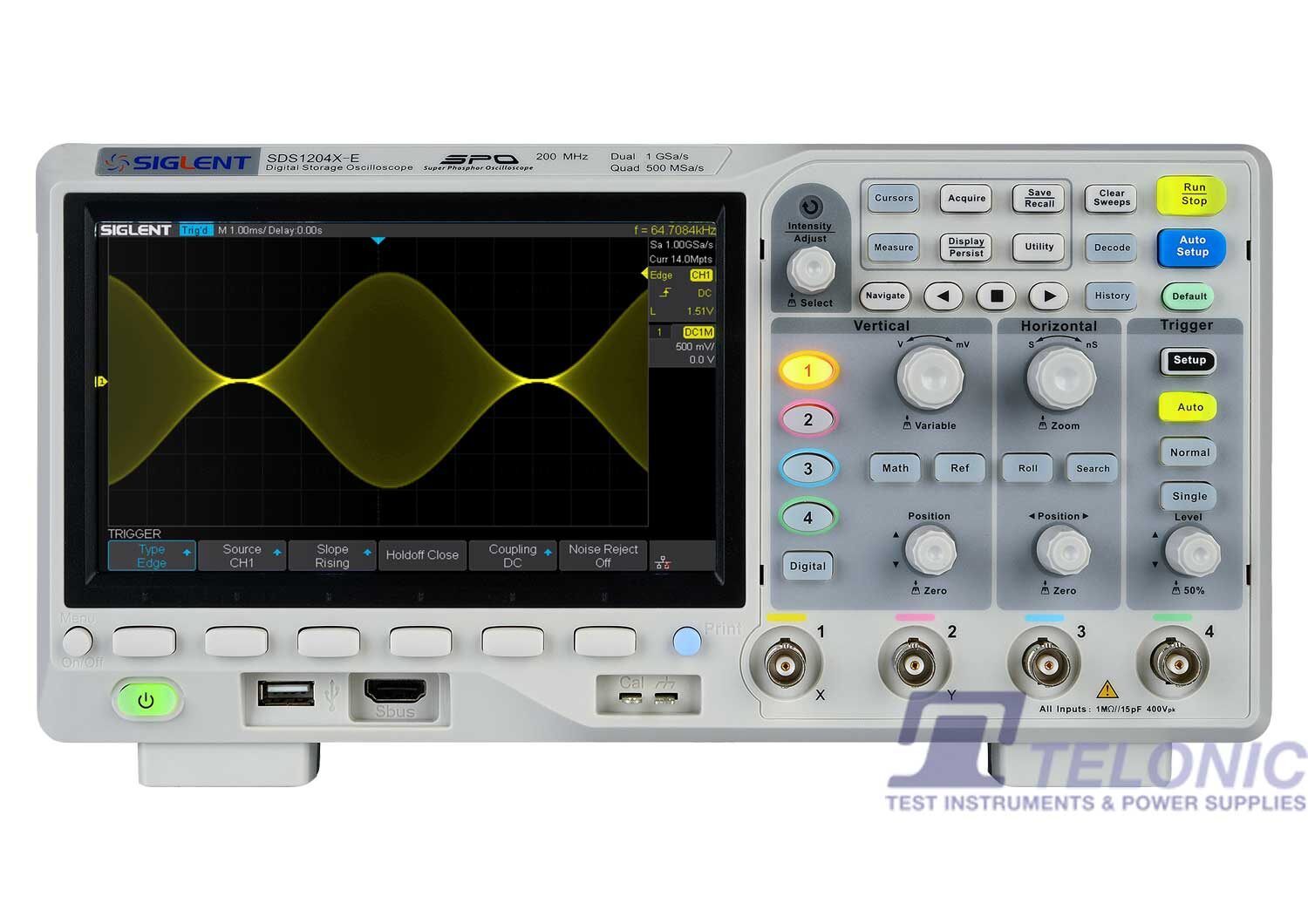
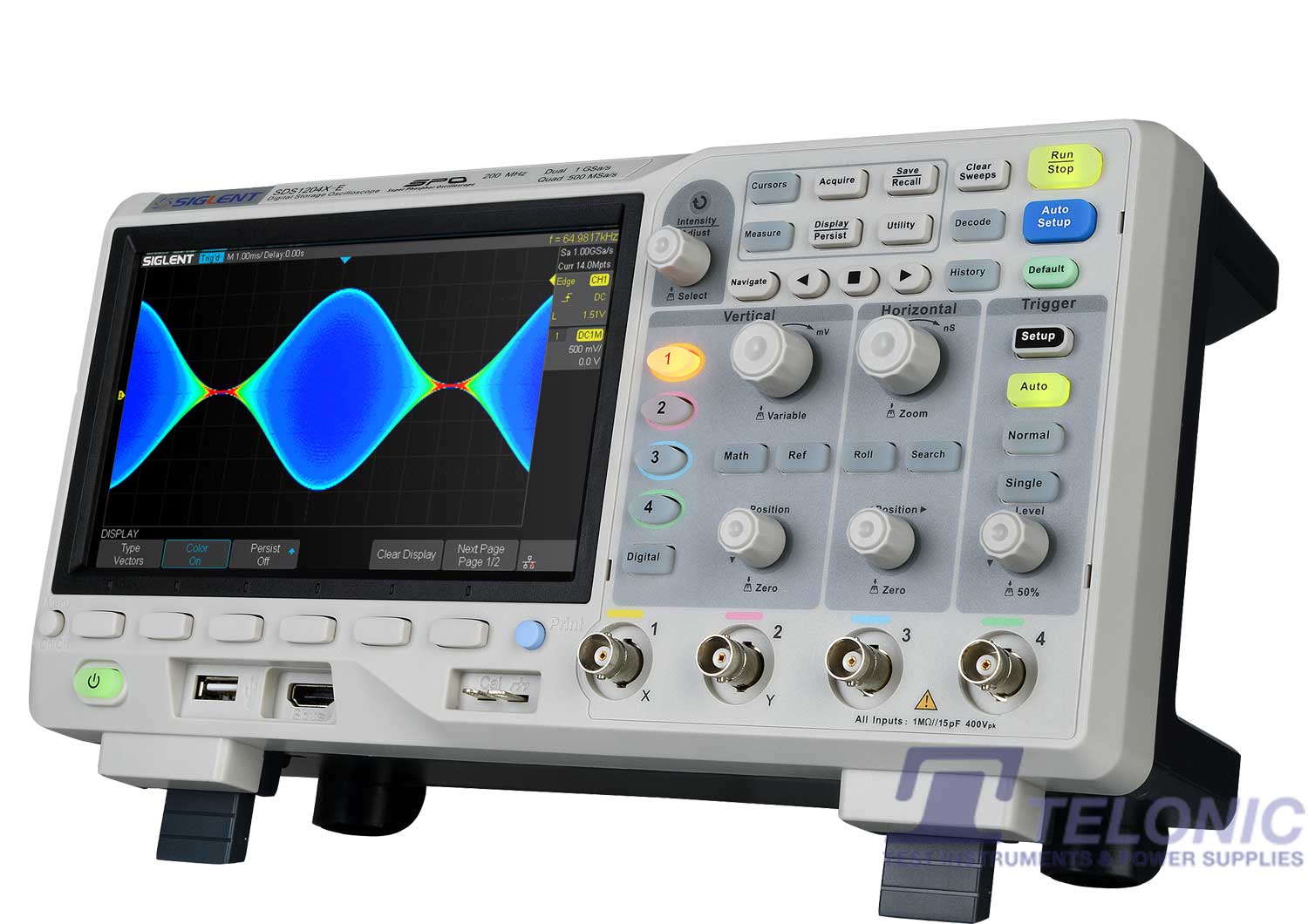
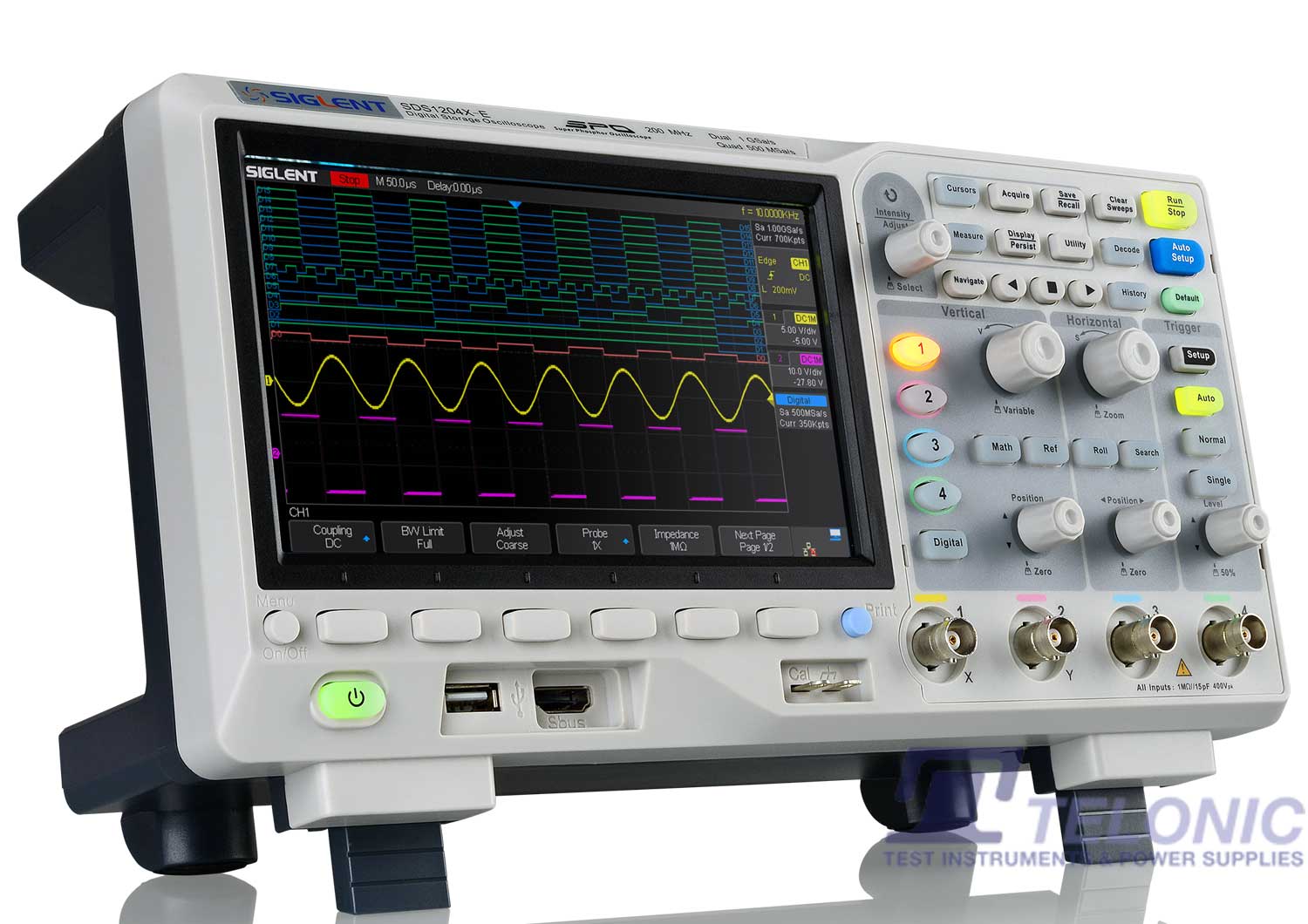

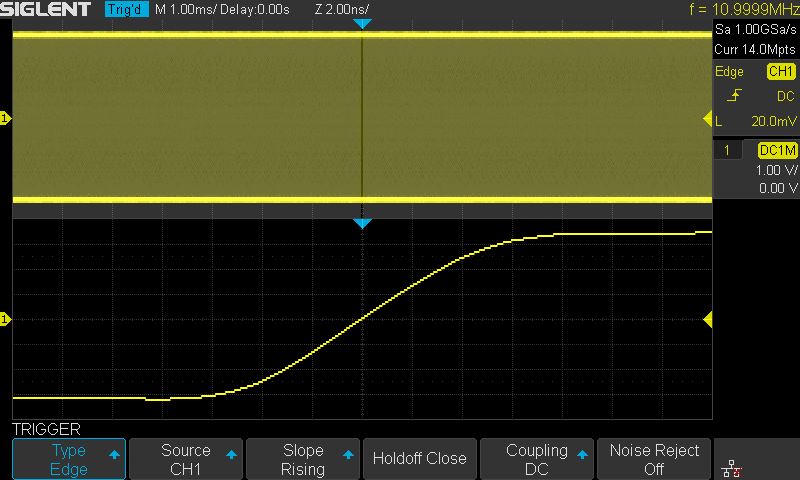
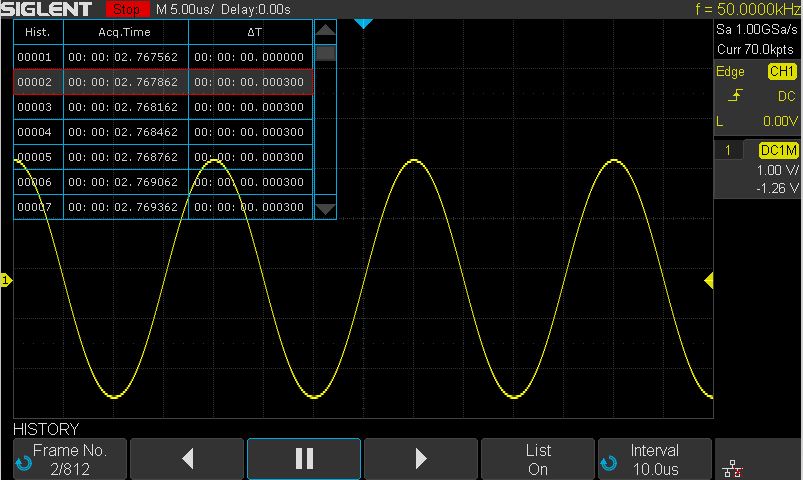
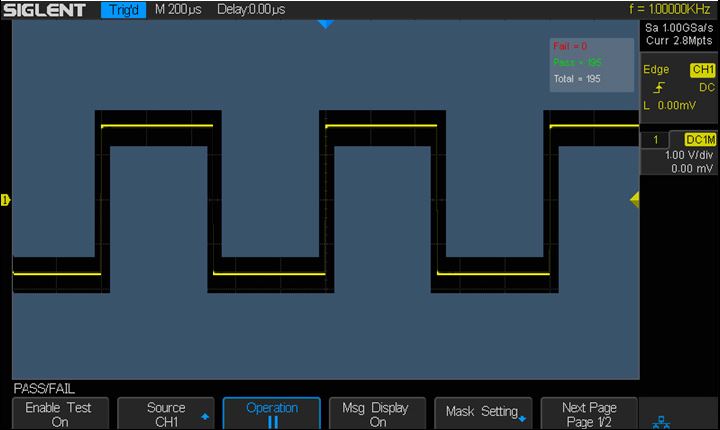
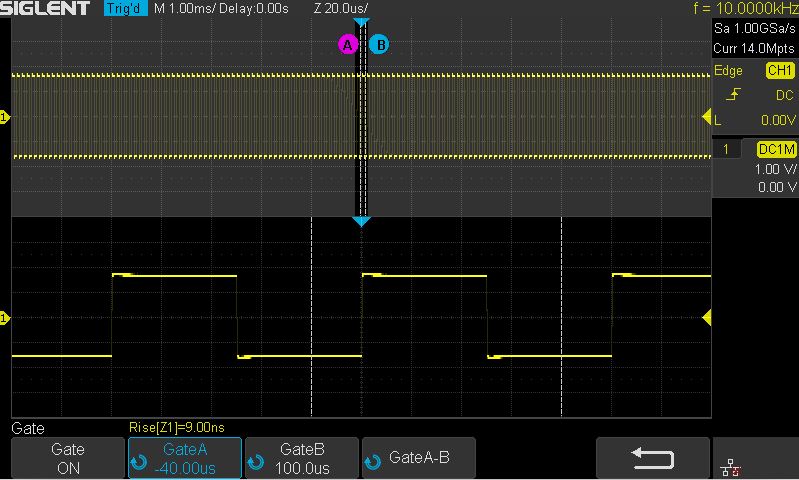

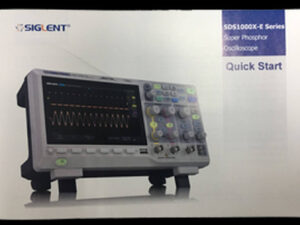
 SDS1000X-E User Manual
Steve Underwood (verified owner) –
The SDS1104X-E feels more solidly constructed than other low cost scopes I have used. It has been working really well, and has a lot of functionality for the price. The fan is a bit noisy, but no worse than most test equipment. There are some inconsistencies in the user interface, but less than competing machines I have used. The product has been available for 5 years, so any bugs should have been sorted out by now, and I have yet to find any significant ones. The USB and LAN remote control functionality is pretty good.
Telonic say they deliver in stock products overnight, and they did.
Dave C –
Big bright screen, intuitive interface and lots of functions for the price. It’s been around for a while so the firmware seems quite well sorted. I’m a hobbyist moving from analogue scopes and it ticks all the boxes for me. The unit seems well made, buttons and controls seem to work well. Nearly bought the Rigol 1054z but this seemed better specified, less clutter on the screen and a much better FFT.
Petar K –
As expected
Austen S –
Cheapest offering for this scope I could find, at least £30-50 better than other suppliers and it came next working day with free delivery.
Rob –
As an infrequent hobby user I wanted a balance on BW and 4 channels. I preferred the panel layout and seemingly more signal on the screen than the Rigol that I very nearly ordered. My only minor negative comment is the fan noise, though it’s not a problem in reality and how it compares with Rigol at the same price point I do not know. Clearly this is a very competitive market space and the optional extras and what’s bundled is a bit confusing.
Darren P –
Useful help deciding on the most appropriate solu3for my needs. Ordered at 2.30pm and arrived the next morning around 10am.
All tidily packed and FREE biscuits.
Definitely recommend.
Thanks Telonic.
John S –
It has been a fair few years since I last needed to use an oscilloscope and things have obviously moved on! The functionality provided by the SDS1104X-E for what it costs has amazed me.
Within a few moments of firing it up I found a bug in the timing of a serial communications link in a product that I have been working on. So far I’m really impressed.
Derek B –
Excellent piece of equipment, well made and performs as expected
Martin C –
There is a lot of functionality in this scope and some unique features.
Unlike some others in this price range, measurements and decoders use the full memory buffer, not just the displayed points.
I particularly like the History feature which allows scroll back to previous triggers without having to be in a specific acquire menu first.
There are only a few negative points: Like most in this price range, it doesn’t have separate vertical gain and position knobs per channel. Unusually, there is no real time clock so screenshots and history waveforms can’t have absolute timestamps. There is a fan going continuously but it is smooth and quiet. However, none of these points are sufficient to prevent it being overall a very capable instrument.